Stroke Symptoms: BE-FAST and What to Do in the First 4.5 Hours
Face droop, one-sided weakness or slurred speech? Learn BE-FAST, why the first 4.5 hours matter, what not to give and why symptoms that disappear still need urgent care.
At breakfast, your father suddenly drops his cup. His words sound slurred and one side of his face looks uneven. Someone says, “Maybe his pressure is high—let him rest.” In stroke, that wait can cost the most valuable thing you have: time.
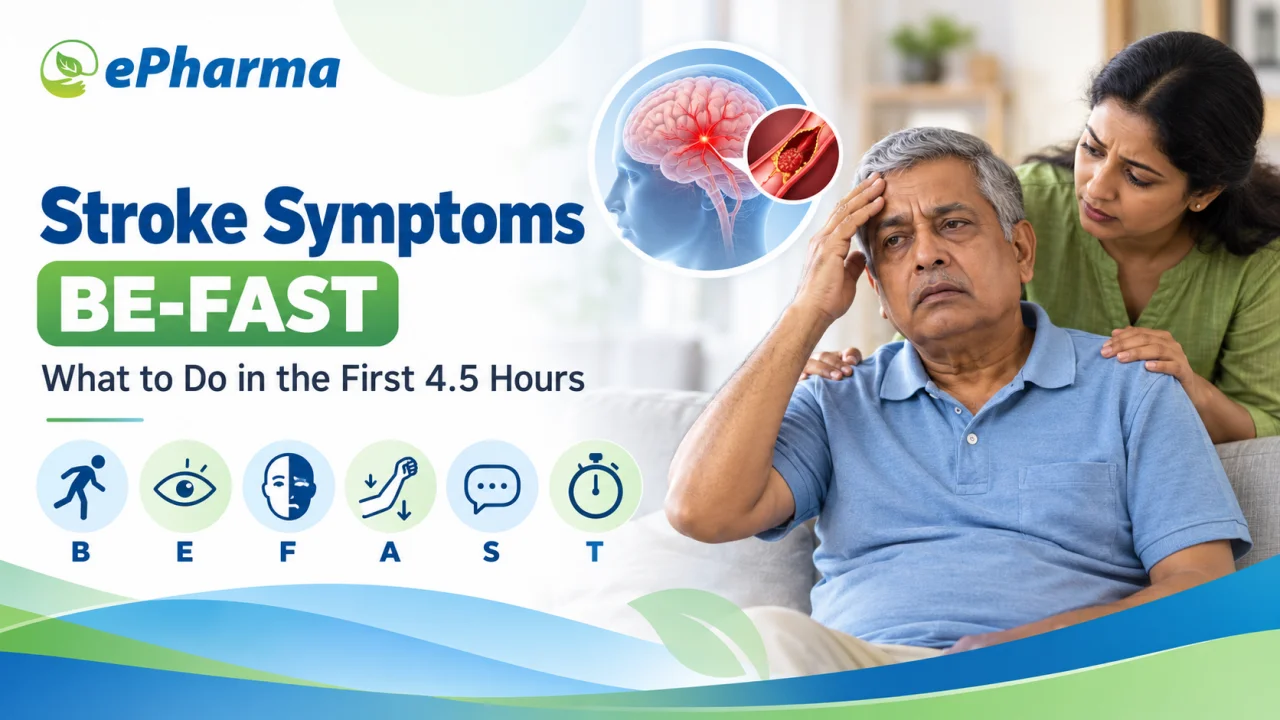
Remember BE-FAST: Balance, Eyes, Face, Arm, Speech, Time. If any of these symptoms starts suddenly, note the onset time and get to a stroke-capable hospital as quickly as possible. Do not give food, water or aspirin. Even if the symptoms disappear after a few minutes, urgent assessment is still needed.
What is a stroke?
A stroke is an emergency affecting blood flow in the brain. There are two main types:
- Ischaemic stroke: a blood clot blocks a vessel. The Bangladeshi neurologist source used here estimates that around 85% of strokes are ischaemic.
- Haemorrhagic stroke: a blood vessel ruptures and causes bleeding in or around the brain.
The two can look similar from the outside. Brain imaging is needed to tell them apart, which is why giving aspirin before assessment can be dangerous.
BE-FAST: the 6 warning signs
| Letter | What to look for | Action |
|---|---|---|
| B — Balance | Sudden dizziness, loss of balance or falling | Treat new sudden symptoms as urgent |
| E — Eyes | Sudden blurred or reduced vision in one or both eyes | Do not wait |
| F — Face | One side of the face droops | Ask the person to smile |
| A — Arm | Sudden weakness or numbness in one arm or leg | New one-sided weakness is an emergency |
| S — Speech | Slurred, confused or difficult speech | Ask for a simple sentence |
| T — Time | Any sign starts suddenly | Note the onset time and go to hospital |
NHS also lists sudden confusion, memory problems, severe headache, nausea/vomiting and one-sided numbness among possible symptoms.
Why do the first 4.5 hours matter?
Bangladeshi stroke specialists describe the first 4.5 hours as a critical treatment window. In selected ischaemic-stroke patients, thrombolysis may be considered after urgent assessment and brain imaging.
Do not treat 4.5 hours as “time to wait.” Hospital assessment, CT imaging and treatment decisions also take time. The source material uses the widely cited estimate that about 1.9 million neurons can be lost each minute during untreated stroke.
What should you do if you suspect stroke?
- Note the time symptoms began. Tell the medical team if the exact time is known.
- Go to a stroke-capable hospital urgently. Ideally, it should have emergency brain imaging and stroke treatment capability.
- Do not let the patient drive. Arrange rapid transport.
- Take a regular-medicine list. Tell the team about blood thinners or antiplatelet medicines.
- Do not give food or water. Stroke can affect swallowing.
What should you not do?
- Do not give aspirin. It can worsen bleeding in haemorrhagic stroke.
- Do not start a new medicine on your own.
- Do not “wait and see.”
- Do not stay home just because the symptoms improve.
What if the symptoms disappear after a few minutes?
This can be a transient ischaemic attack (TIA), sometimes called a mini-stroke. NHS guidance says medical help is still needed urgently because a TIA can be a warning sign of a future major stroke.
What are the major stroke risk factors in Bangladesh?
A nationwide Bangladesh survey found the following risk factors among people who had experienced stroke:
- Hypertension — 79.2%
- Dyslipidaemia — 38.9%
- Tobacco use — 37.2%
- Diabetes — 28.8%
- Ischaemic heart disease — 20.1%
These percentages describe how common the risk factors were in the surveyed stroke population; they do not prove that each factor caused an individual stroke.
How can you reduce stroke risk?
- check blood pressure regularly
- take prescribed blood-pressure treatment as directed
- control diabetes and cholesterol
- avoid tobacco
- stay physically active and maintain a healthy weight
See our home blood-pressure measurement guide.
Is stroke the same as a heart attack?
No. A heart attack affects blood flow to the heart; a stroke affects the brain. Both are time-critical emergencies, but their symptoms and treatment are different.
When should you seek emergency care immediately?
- sudden facial droop
- sudden one-sided weakness or numbness
- sudden speech difficulty
- sudden loss of vision
- sudden loss of balance
- sudden severe headache, confusion or collapse
Common myths
- “The symptoms went away, so it was not a stroke.” It may have been a TIA and still needs urgent assessment.
- “Aspirin is always helpful.” It can be harmful if the stroke is caused by bleeding.
- “Only elderly people have strokes.” Younger adults with major risk factors can also be affected.
- “There are 4.5 hours, so there is plenty of time.” No. Imaging and treatment decisions must happen inside that window.
Frequently asked questions
What are the first signs of stroke?
Sudden facial droop, one-sided weakness, slurred speech, visual change or loss of balance. Remember BE-FAST.
What does BE-FAST mean?
Balance, Eyes, Face, Arm, Speech and Time.
How long is the golden treatment window?
For selected ischaemic-stroke patients, thrombolysis may be considered within about 4.5 hours after symptom onset. The patient should still get to hospital as fast as possible.
Can you give water to someone having a stroke?
No. Swallowing can be impaired, which raises the risk of aspiration.
Should you give aspirin?
No, not before brain imaging. Aspirin can worsen a bleeding stroke.
What if symptoms disappear?
Urgent medical assessment is still needed because it may be a TIA.
What is the biggest stroke risk factor?
Hypertension is a major risk factor. In the Bangladesh survey used here, 79.2% of stroke patients had hypertension.
Related reading
Sources
- Dr Himel Biswas — Prothom Alo, 12 December 2025.
- Bangladesh Medical University seminar coverage — Prothom Alo, 16 October 2022.
- Prof. Dr Md. Hasanuzzaman — The Daily Star Bangla, 30 October 2023 and 30 October 2022.
- Mondal MBA et al. — eNeurologicalSci, 2022.
- NHS — Stroke symptoms.
- Baystate Health — BEFAST stroke warning signs.
This article is for general health information. If stroke is suspected, seek urgent hospital assessment rather than trying home treatment. Do not start, stop or change medicines without medical advice.
Related Products