Normal Cholesterol Levels: Lipid Profile & Urine Report Guide
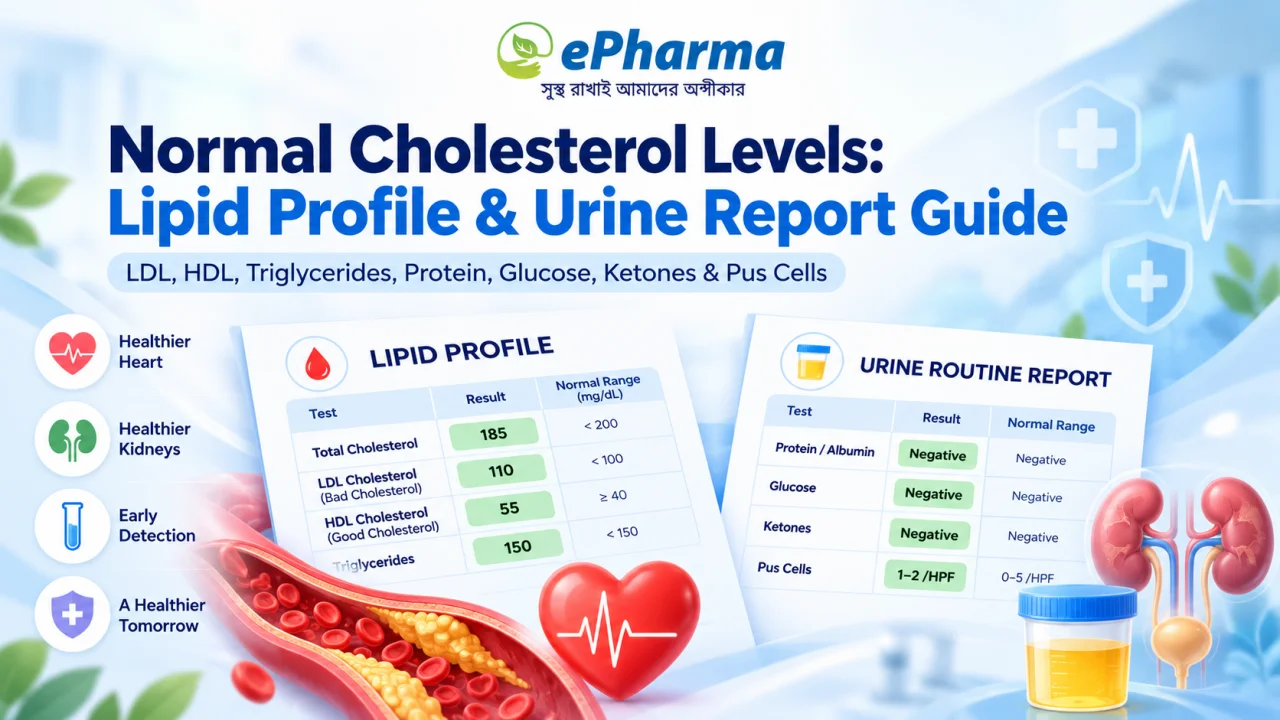
Understand normal total cholesterol, LDL, HDL and triglyceride levels, plus what protein, glucose, ketones and pus cells in a urine report may mean.
A lipid profile and a routine urine report can look like a wall of numbers, but they answer different questions. A lipid profile helps estimate cardiovascular risk, while urinalysis can provide clues about kidney problems, urinary infection, diabetes and other conditions. The safest way to read either report is to look at the pattern rather than one isolated number.
What does each lipid-profile number mean?
| Test | What it reflects | General direction |
|---|---|---|
| Total cholesterol | Overall cholesterol in the blood | Lower is generally better |
| LDL-C | The cholesterol fraction most closely linked with plaque build-up | Lower targets for higher-risk patients |
| HDL-C | A marker involved in cholesterol transport | Very low levels are undesirable |
| Triglycerides | Another type of blood fat | Lower is generally better |
| Non-HDL | Total cholesterol minus HDL | A useful summary of atherogenic cholesterol |
What are normal cholesterol levels?
MedlinePlus gives these general desirable levels:
| Measure | Age ≤19 | Men ≥20 | Women ≥20 |
|---|---|---|---|
| Total cholesterol | <170 mg/dL | <200 mg/dL | <200 mg/dL |
| Non-HDL | <120 | <130 | <130 |
| LDL | <110 | <100 | <100 |
| HDL | >45 | ≥60 is best; <40 is low | ≥60 is best; <50 is low |
Triglycerides: below 150 mg/dL is generally desirable; 150–199 is borderline high and 200 or more is high.
Converting mg/dL to mmol/L
- Total/LDL/HDL cholesterol: mg/dL ÷ 38.67 = mmol/L
- Triglycerides: mg/dL ÷ 88.57 = mmol/L
What should your LDL target be?
There is no single LDL target for everyone. For most healthy adults, MedlinePlus lists LDL <100 mg/dL as desirable. But the 2026 ACC/AHA dyslipidemia guideline uses risk-based goals. For people with very-high-risk ASCVD, the recommended LDL-C goal is <55 mg/dL. Many people with established ASCVD who are not in the very-high-risk category have a goal of <70 mg/dL.
Diabetes, chronic kidney disease, severe hypercholesterolemia, smoking, blood pressure and previous cardiovascular events can all change the treatment threshold. A number that is “normal” on a lab sheet may not be the right personal target for a high-risk patient.
How often should cholesterol be checked?
| Group | General schedule |
|---|---|
| Children/adolescents | First test around ages 9–11, then generally every 5 years; earlier testing may be advised for strong family history |
| Adults 20–65 | Lower-risk younger adults generally every 5 years |
| Men 45–65, women 55–65 | Every 1–2 years |
| Older than 65 | Every year |
People with diabetes, hypertension, CKD, known heart disease, treatment for high cholesterol or previously abnormal results may need more frequent testing.
Do you need to fast before a lipid profile?
MedlinePlus advises fasting for 9–12 hours before a cholesterol panel. In modern practice, some routine lipid tests may be done non-fasting, depending on the clinical question. Follow your clinician or laboratory instructions, especially when triglyceride interpretation is important.
What does a routine urine report check?
Urinalysis examines physical appearance, chemical dipstick findings and microscopic findings. MedlinePlus notes that glucose, ketones, protein and bilirubin are usually not detectable in normal urine; blood, nitrites, red blood cells and white blood cells are not normally expected either. Reference ranges vary by laboratory.
| Finding | What an abnormal result may suggest |
|---|---|
| Protein / albumin | Persistent positivity can be a marker of kidney damage |
| Glucose | May be a clue to high blood glucose, but cannot diagnose diabetes by itself |
| Ketones | May occur with fasting, low-carbohydrate states or diabetic ketoacidosis |
| Blood / RBC | Can occur with stones, infection, kidney or urinary-tract disease, or contamination |
| Nitrite / leukocyte esterase | Can support suspicion of urinary infection |
| WBC / pus cells | Can increase with infection, inflammation or contamination |
| Epithelial cells | Many squamous cells may suggest a contaminated sample |
How many pus cells are normal in urine?
Laboratory reference ranges vary. The University of Utah WebPath educational reference describes fewer than 2 WBC/HPF in a clean specimen as normal. Other laboratories may use a different reference interval. A small rise in pus cells does not automatically mean you need antibiotics; symptoms, sample quality and—when appropriate—urine culture matter.
What does “trace albumin” or “protein +” mean?
A single trace result does not automatically mean chronic kidney disease. Dehydration, strenuous exercise, fever and urinary infection can cause temporary proteinuria. Repeated albumin/protein findings—especially in people with diabetes or hypertension—may need urine ACR and serum creatinine/eGFR follow-up.
For kidney-function interpretation, see Creatinine Normal Range: Kidney Test, eGFR and Urine ACR Explained.
Does glucose in urine mean diabetes?
Not necessarily. Urine glucose is a clue, not a diagnostic test. MedlinePlus notes that blood glucose can be high even when urine glucose is normal, and urine glucose can also rise in pregnancy or certain kidney disorders. Diabetes is confirmed with appropriate blood testing such as plasma glucose or HbA1c.
How to provide a cleaner urine sample
- Use the sterile container provided by the laboratory.
- Wash your hands and clean the genital area.
- Start urinating into the toilet, then collect a midstream sample.
- Do not touch the inside of the container.
- Deliver the sample promptly according to lab instructions.
- Tell the lab or clinician if menstruation may contaminate the sample.
When should you seek prompt medical review?
- Chest pain, severe shortness of breath or stroke-like symptoms
- LDL-C ≥190 mg/dL
- Very high triglycerides; ≥500 mg/dL deserves prompt review, and pancreatitis risk becomes particularly important at much higher levels, especially around ≥1000 mg/dL
- Visible blood in urine
- Repeated protein/albumin with swelling
- Positive ketones with vomiting, abdominal pain, rapid breathing or severe illness
- Urinary symptoms with fever, chills or flank pain
Common myths
| Myth | What is more accurate |
|---|---|
| “I am thin, so my cholesterol cannot be high.” | Genetics, diet, activity, diabetes, age and other factors matter too. |
| “My total cholesterol is normal, so the whole lipid profile is fine.” | LDL, HDL, triglycerides and non-HDL should be interpreted separately. |
| “LDL below 100 is enough for everyone.” | Higher-risk patients may have much lower treatment goals. |
| “A few pus cells mean I need antibiotics.” | Symptoms, contamination risk and sometimes culture are needed. |
| “Trace protein means kidney failure.” | Temporary causes exist; persistent findings need proper follow-up. |
Related ePharma health guides
Frequently asked questions
What is a normal total cholesterol level?
For adults, MedlinePlus lists total cholesterol below 200 mg/dL as generally desirable.
What should LDL be?
Below 100 mg/dL is a general desirable level, but people at high cardiovascular risk may have a much lower treatment goal.
What is a good HDL level?
MedlinePlus describes 60 mg/dL or higher as best; below 40 in men and below 50 in women is considered low.
What is a normal triglyceride level?
Below 150 mg/dL is generally desirable; 150–199 is borderline high and 200 or more is high.
Do I need to fast for a lipid profile?
MedlinePlus advises 9–12 hours of fasting, but some clinical situations allow non-fasting testing. Follow your lab or clinician's instructions.
Do increased urine pus cells always mean UTI?
No. Infection, inflammation and sample contamination can all raise white blood cells in urine.
What does trace albumin in urine mean?
It may be temporary, but repeated albumin/protein findings—especially with diabetes or hypertension—deserve kidney evaluation.
Does urine glucose diagnose diabetes?
No. Urine glucose alone cannot diagnose diabetes; appropriate blood glucose or HbA1c testing is needed.
This article provides general health information and is not a diagnosis or a substitute for personal medical advice. Use your laboratory's reference ranges and discuss abnormal or persistent findings with a qualified clinician. Do not start, stop or change cholesterol medicines or antibiotics on your own.
Sources
- MedlinePlus — Cholesterol Levels: What You Need to Know.
- 2026 ACC/AHA Guideline on the Management of Dyslipidemia.
- MedlinePlus — Urinalysis; Glucose in Urine; Urine Protein Dipstick; Ketones in Urine.
- University of Utah WebPath — Urinalysis educational reference.
- KDIGO 2024 CKD Guideline — albuminuria assessment.
Related Products