


How to Spot Fake Medicine: Expiry, Batch Numbers & Safe Storage
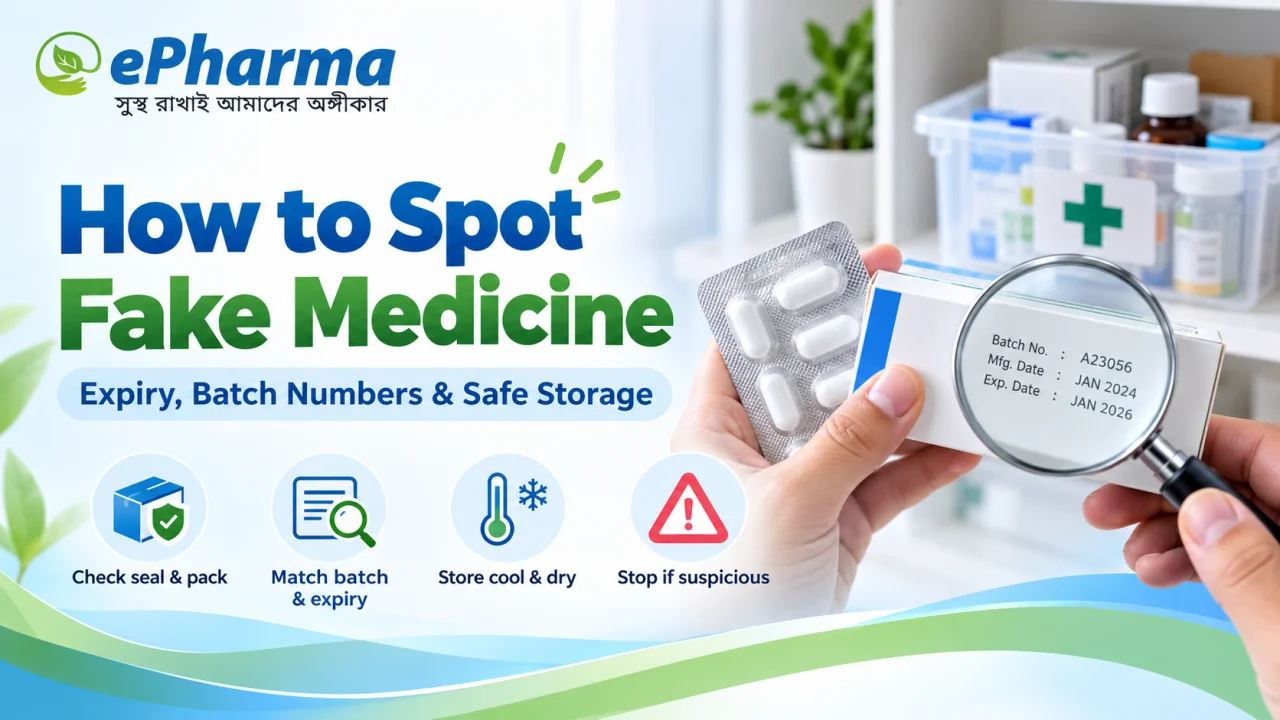
Learn a practical 6-point fake-medicine checklist, how to check batch and expiry details, what to do with suspicious medicine, and safe storage and disposal.
Mr Hasan has been taking the same long-term medicine for years. One day, after buying a new box from a different shop, he notices something odd: the batch number on the outer box does not match the blister strip, and the tablets look slightly different. That immediately raises the question: is this medicine genuine?
It is a question people ask pharmacies all the time. Price or packaging alone cannot prove authenticity, but a structured check of the seal, label, batch and expiry, tablet or capsule appearance, verification features and source can help you spot red flags early and avoid unnecessary risk.
Substandard and falsified medicines are not the same
The World Health Organization (WHO) distinguishes two important categories:
| Category | What it means |
|---|---|
| Substandard medicine | An authorized medical product that fails to meet quality standards or specifications, often because of manufacturing or quality-control problems |
| Falsified medicine | A product that deliberately misrepresents its identity, composition or source |
WHO estimates that at least 1 in 10 medicines in low- and middle-income countries may be substandard or falsified. WHO also warns that unauthorized sources, informal markets and unfamiliar online sellers can increase risk.
How to spot a fake medicine: a 2-minute, 6-point checklist
1. Check the seal and packaging
- Make sure the box, bottle cap or blister seal looks intact.
- Look for blurry printing, spelling errors, colour mismatch, crooked labels or signs that the package has been opened and resealed.
- If you have a previous genuine pack, a side-by-side comparison can help—but manufacturers may update packaging, so a visual difference alone is not proof of falsification.
2. Match the information on the box and blister
- Medicine name and strength
- Manufacturer name
- Batch or lot number
- Manufacturing and expiry dates
- Storage instructions
If both the outer box and inner strip carry batch and expiry details, they should match. FIP/ICN/USP visual-inspection guidance also emphasizes that medicine-label information should be clear, legible and resistant to tampering.
3. Inspect the tablets or capsules
- Are the colour, size, shape and imprint consistent across the strip?
- Are any tablets chipped, powdery, stained or unusually soft?
- Are any capsules empty, partly open or damaged?
- Is there an unusual smell or appearance compared with the product you know?
A visual difference by itself does not prove a medicine is counterfeit. But if several red flags appear together, do not use the product until it is verified by a pharmacist, manufacturer or regulator.
4. Check the expiry date and batch carefully
Do not use expired medicine. Avoid products where the expiry date appears rubbed off, overwritten, covered with a sticker or inconsistent between the box and strip. If the pack uses a month/year expiry format, follow the manufacturer’s label or leaflet rather than guessing how the date should be interpreted.
5. Use official verification features when they are present
Some medicine packs include a manufacturer- or regulator-provided QR code, authentication code or other verification feature. When present, follow the official instructions printed on the pack. Bangladesh regulatory material also refers to DGDA drug-verification systems. Not every medicine has a QR or authentication code, so the absence of one does not mean the product is fake.
6. Check the source
- Buy from a drug-licensed pharmacy or established healthcare retailer.
- For prescription medicines, prefer sellers that can provide registered pharmacist support.
- Keep the cash memo, invoice or digital order record.
- Be extra cautious with unusually low prices, anonymous social-media pages, hawkers or sellers whose identity and licence cannot be verified.
What if a medicine suddenly seems less effective?
If a long-term medicine for blood pressure, diabetes, epilepsy or another chronic condition suddenly seems less effective, do not simply increase the dose yourself. Tell your clinician about the medicine source, batch, storage and packaging. Treatment failure can have many causes, including poor adherence, interactions, disease progression, storage problems or product quality.
For home monitoring, see our blood pressure monitoring guide and glucometer guide.
What should you do if you suspect a fake medicine?
- Do not keep using the medicine when there is a serious packaging, label or batch mismatch.
- Keep the box, blister, batch number, expiry details and cash memo or order record.
- Contact the pharmacy and, when appropriate, the manufacturer to verify the batch.
- Report the suspected product through DGDA or the relevant regulatory channel.
- If you develop rash, breathing difficulty, severe vomiting, unusual drowsiness or another serious reaction after taking it, seek medical care promptly.
What should you do with expired medicines?
Once a medicine is past its labelled expiry date, the manufacturer no longer guarantees its potency, quality or stability. The idea that an expired medicine is “probably fine for a few more months” is not a safe assumption. Storage and expiry instructions are especially important for medicines such as insulin, eye drops, reconstituted liquids and temperature-sensitive products.
For more detail, see our insulin pen and storage guide.
How should old medicines be disposed of?
If a medicine take-back programme or pharmacy collection service is available, that is usually the best option. When no take-back option exists, MedlinePlus general disposal guidance recommends:
- Do not flush medicine into a toilet or sink unless the label or an official local instruction specifically tells you to.
- Mix tablets or capsules with an undesirable material such as used coffee grounds, used tea leaves or soil.
- Seal the mixture in a bag or container before putting it in household trash.
- Remove personal information from prescription labels.
- Keep discarded medicines away from children and pets.
How to store medicines safely at home
| Do | Avoid |
|---|---|
| Keep medicines in a cool, dry place | Bathroom cabinets, damp areas or next to the sink |
| Keep the original box or blister | Mixing multiple medicines in an unlabelled container |
| Store out of sight and reach of children, preferably locked | Leaving medicine open on a bedside table |
| If the label says refrigerate, follow that exact instruction | Putting medicines in the freezer or refrigerator door without instructions |
| Review expiry dates regularly | Keeping leftover antibiotics “for next time” |
MedlinePlus notes that heat, air, light and moisture can damage medicines. That is why bathroom storage is often a poor choice; a dry drawer or cabinet is generally better unless the label says otherwise.
Common myths
| Myth | Reality |
|---|---|
| “If a shop sold it, it must be genuine.” | Source matters, but checking the seal, batch and expiry is still useful. |
| “No QR code means fake.” | No. Not every medicine has a QR or authentication code. |
| “A very low price always means fake.” | No, but an unexplained unusually low price can add concern when other red flags are present. |
| “Expired medicine is fine for a few more months.” | After expiry, the manufacturer no longer guarantees quality or stability. |
| “The bathroom cabinet is the best place for medicine.” | Heat and moisture can damage medicines. |
| “If the medicine is not working, just increase the dose.” | Do not self-adjust; review adherence, storage, source and disease status with a clinician. |
Frequently asked questions
What is the easiest way to spot a fake medicine?
Check six things together: seal and printing, batch and expiry match, tablet or capsule appearance, official verification features and the seller or source.
What is the difference between substandard and falsified medicine?
A substandard product is authorized but fails to meet quality specifications. A falsified product deliberately misrepresents its identity, composition or source.
Why is the batch number important?
The batch number identifies a production lot. If the box and blister batch numbers do not match, verify the product before using it.
Does a medicine need a QR code to be genuine?
No. Not every medicine uses QR or authentication codes. Packaging, label, batch, expiry and source still matter.
What should I do if I suspect a fake medicine?
Stop using the suspicious pack, keep the packaging and receipt, verify with the seller or manufacturer and report it to the relevant regulator. Seek medical care if you have a serious reaction.
Can I use expired medicine?
No. Once it is past the labelled expiry date, the manufacturer no longer guarantees potency, quality or stability.
Where should medicines be stored at home?
Unless the label says otherwise, keep them in a cool, dry place in the original packaging and out of reach of children. Avoid bathrooms, direct sunlight and heat sources.
How should expired medicine be discarded?
Use a take-back service if available. Otherwise follow label or local guidance and place the medicine with an undesirable material in a sealed bag or container before household disposal; remove personal information.
Is buying medicine online safe?
Prefer a licensed, traceable pharmacy or healthcare seller with identifiable pharmacist support. Avoid anonymous or unauthorized online sellers.
Related reading
- What Happens If You Do Not Finish an Antibiotic Course?
- How Often Can You Take Paracetamol?
- How to Use an Insulin Pen
Sources
- World Health Organization — Substandard and falsified medical products.
- FIP / ICN / USP — A tool for visual inspection of medicines.
- Directorate General of Drug Administration / Bangladesh AMR action-plan material — drug-verification systems.
- MedlinePlus — Storing your medicines.
- Bangladesh news reporting on counterfeit and falsified medicine enforcement.
This article is for general health information. Visual inspection cannot prove with 100% certainty that a medicine is genuine. If you are concerned, do not keep using the suspicious pack until it is verified by a pharmacist, manufacturer or regulator, and do not permanently stop or change prescribed treatment without clinical advice.
[executed on device: Aziz-MacBook.local (e21e2c25-9602-4c8d-b57a-8ddf9e985cd7)]










