Normal Hemoglobin Levels & CBC Report: WBC, Platelets, MCV and ESR
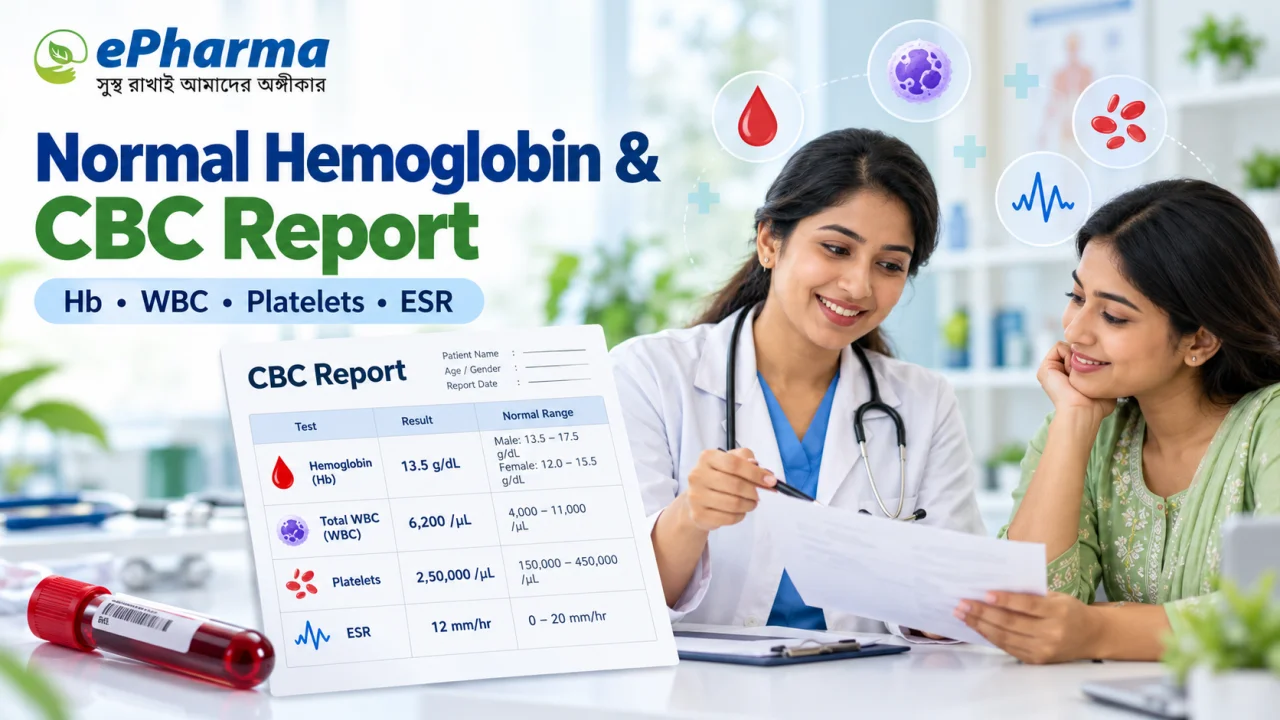
Not sure what the highlighted numbers on a CBC report mean? Learn WHO hemoglobin anaemia cut-offs, common CBC reference ranges, and how to interpret WBC, platelets, MCV, PCV and ESR safely.
A CBC report can look alarming when one or two numbers are flagged in red. Hemoglobin may be 11.2, WBC may sit just outside the printed range, or ESR may be high. The safest way to read the report is not to diagnose from one number, but to consider the whole CBC together with age, sex, pregnancy status, symptoms and the laboratory's own reference range.
This guide explains the main CBC fields—hemoglobin, RBC, hematocrit/PCV, WBC, platelets, MCV, MCH and MCHC—and shows how WHO hemoglobin cut-offs are used to define anaemia. It also explains why ESR is a non-specific marker rather than a diagnosis.
What hemoglobin level is considered normal?
The WHO 2024 guideline gives hemoglobin cut-offs for defining anaemia. A value at or above the cut-off means anaemia is not defined by hemoglobin alone; it does not automatically mean every aspect of the blood count is ideal. Your laboratory reference range and clinical context still matter.
| Group | No anaemia (Hb, g/dL) | Mild | Moderate | Severe |
|---|---|---|---|---|
| Children 6–23 months | ≥ 10.5 | 9.5–10.4 | 7.0–9.4 | < 7.0 |
| Children 24–59 months | ≥ 11.0 | 10.0–10.9 | 7.0–9.9 | < 7.0 |
| Children 5–11 years | ≥ 11.5 | 11.0–11.4 | 8.0–10.9 | < 8.0 |
| Children 12–14 years | ≥ 12.0 | 11.0–11.9 | 8.0–10.9 | < 8.0 |
| Men 15–65 years | ≥ 13.0 | 11.0–12.9 | 8.0–10.9 | < 8.0 |
| Non-pregnant women 15–65 years | ≥ 12.0 | 11.0–11.9 | 8.0–10.9 | < 8.0 |
| Pregnancy—1st trimester | ≥ 11.0 | 10.0–10.9 | 7.0–9.9 | < 7.0 |
| Pregnancy—2nd trimester | ≥ 10.5 | 9.5–10.4 | 7.0–9.4 | < 7.0 |
| Pregnancy—3rd trimester | ≥ 11.0 | 10.0–10.9 | 7.0–9.9 | < 7.0 |
Watch the unit: WHO publishes the table in g/L; the values above are converted to g/dL. For example, 120 g/L equals 12 g/dL. Altitude and smoking can also affect hemoglobin interpretation.
What does each field in a CBC report mean?
| Field | What it measures |
|---|---|
| Hemoglobin (Hb) | The oxygen-carrying protein inside red blood cells |
| RBC count | The number of red blood cells |
| Hematocrit / PCV | The percentage of blood made up of red blood cells |
| MCV | Average red blood cell size |
| MCH / MCHC | Hemoglobin amount/concentration in red blood cells |
| WBC / total count | The total number of white blood cells |
| Platelets | Cells that are important for blood clotting |
| ESR | How quickly red cells settle in one hour; a non-specific marker of inflammation |
Common adult CBC reference ranges
UCSF Health lists the following examples for adults. Reference ranges vary by laboratory, so the range printed beside your own result should take priority.
| Test | Common reference example |
|---|---|
| Hemoglobin | Men 13–18 g/dL; women 12–16 g/dL |
| Hematocrit / PCV | Men 40–55%; women 36–48% |
| RBC | Men 4.6–6.2 million/µL; women 4.2–5.4 million/µL |
| WBC | 4,500–11,000/µL |
| Platelets | About 150,000–400,000/µL |
| MCV | 80–100 fL |
| MCH | 27–32 pg/cell |
| MCHC | 32–36 g/dL |
Some Bangladesh laboratory reports use ×10⁹/L. A WBC count of 4.5–11 ×10⁹/L is equivalent to 4,500–11,000/µL; platelets of 150–400 ×10⁹/L correspond to 150,000–400,000/µL.
What can cause low hemoglobin?
Low hemoglobin does not automatically mean iron deficiency. WHO notes that anaemia can be related to nutritional deficiencies, blood loss, infections, chronic disease and inherited red-cell disorders such as thalassaemia. That is why starting iron or vitamins purely from a low Hb result is not a safe shortcut.
Anaemia may cause tiredness, weakness, dizziness, cold hands and feet, headache or shortness of breath on exertion. More severe anaemia can cause marked pallor, palpitations, rapid breathing or fainting.
For causes, diet and when to seek care, see Anaemia: Symptoms, Causes, Iron-Rich Foods, Tests and When to See a Doctor.
What does a low or high MCV mean?
MCV describes the average size of red blood cells. It helps clinicians narrow down possible types of anaemia, but it is not a diagnosis on its own.
| MCV | Pattern | Common examples |
|---|---|---|
| < 80 fL | Microcytic | Iron deficiency, thalassaemia trait |
| 80–100 fL | Normocytic | Chronic disease, acute blood loss and other causes |
| > 100 fL | Macrocytic | Vitamin B12/folate deficiency, liver disease and other causes |
If hemoglobin and MCV are both low, a clinician may consider ferritin/iron studies and, where appropriate, haemoglobin electrophoresis. This is particularly important when thalassaemia trait is possible, because the cause should be established before prolonged iron treatment.
What is a normal WBC count?
A common adult reference example is 4,500–11,000/µL. WBC can rise with infections, inflammation, corticosteroid medicines, allergies, physical or emotional stress and other conditions. A low WBC count may occur with some viral infections, medicines, liver/spleen disorders or bone-marrow conditions.
A high WBC count does not automatically mean antibiotics are needed. The differential count, symptoms and clinical assessment help identify the cause.
What is a normal platelet count?
A common adult reference example is about 150,000–400,000/µL. Platelets can fall for many reasons; dengue is one of them, but the platelet count alone does not define dengue severity. For dengue-specific interpretation, read How to Read a Dengue Report: NS1, CBC, Platelets and Hematocrit.
Seek urgent medical care if a low platelet count is accompanied by gum/nose bleeding, blood in vomit or stool, unusual bruising or other bleeding.
What is a normal ESR?
MedlinePlus lists the following Westergren-method reference examples:
| Group | Reference |
|---|---|
| Men under 50 | < 15 mm/hr |
| Men over 50 | < 20 mm/hr |
| Women under 50 | < 20 mm/hr |
| Women over 50 | < 30 mm/hr |
| Newborns | 0–2 mm/hr |
| Children to puberty | 3–13 mm/hr |
ESR is non-specific. A raised ESR can support evidence of inflammation, but it does not prove tuberculosis, arthritis, infection, cancer or any other single diagnosis. Anaemia, pregnancy, kidney disease, thyroid disease and inflammatory conditions can all affect ESR.
Do you need to fast before a CBC?
For a CBC alone, fasting is usually not required; UCSF Health states that no special preparation is needed. If fasting glucose, a lipid profile or another test is being drawn at the same time, instructions may be different. Follow the laboratory or clinician's directions.
When should you seek medical care promptly?
- Low hemoglobin with shortness of breath, palpitations, fainting or marked weakness
- Black stools, vomiting blood or unusually heavy bleeding
- Low platelets with active bleeding
- Very high or very low WBC together with fever or significant illness
- Low hemoglobin during pregnancy
- Low hemoglobin in a child with reduced feeding, play or activity
WHO classifies Hb below 8 g/dL as severe anaemia in several adult groups, while some pregnancy and young-child groups use a severe threshold below 7 g/dL. Urgency, however, depends on more than a number—symptoms, active bleeding, heart/lung disease, pregnancy and how quickly the hemoglobin has fallen all matter.
Common myths about CBC results
| Myth | What is more accurate |
|---|---|
| “Low hemoglobin always means take iron.” | Iron deficiency is common, but it is not the only cause of anaemia. |
| “A high ESR means TB or arthritis.” | ESR is non-specific and needs clinical context and often other tests. |
| “A high WBC means I need antibiotics.” | Many non-bacterial causes can raise WBC. |
| “Low platelets mean dengue is severe.” | Dengue severity depends on warning signs and the overall clinical picture, not platelet count alone. |
| “A flagged result always means disease.” | Laboratory ranges differ and small deviations may or may not be clinically important. |
| “You must fast for a CBC.” | A CBC alone usually does not require fasting. |
Frequently asked questions
What is a normal hemoglobin level?
Under the WHO 2024 anaemia cut-offs, hemoglobin of at least 13 g/dL in men aged 15–65 and at least 12 g/dL in non-pregnant women aged 15–65 is not classified as anaemia. Child and pregnancy cut-offs vary by age and trimester.
What hemoglobin level is severe anaemia?
WHO classifies Hb below 8 g/dL as severe anaemia in many adult groups. Some pregnancy and young-child groups use below 7 g/dL. Symptoms and active bleeding can make a situation urgent at other values as well.
What is a normal WBC count?
A common adult range is 4,500–11,000/µL, but use the reference range printed on your report.
What is a normal platelet count?
A common adult range is about 150,000–400,000/µL. Laboratory ranges may differ.
What does a high ESR mean?
It can indicate inflammation, but it is not specific enough to diagnose one condition by itself.
What does a low MCV mean?
MCV below 80 fL is microcytic. Iron deficiency and thalassaemia trait are common possibilities, among others.
Do I need to fast before a CBC?
Usually not for a CBC alone. Follow instructions if other tests are being done at the same time.
Sources
- World Health Organization — Guideline on haemoglobin cutoffs to define anaemia in individuals and populations
- World Health Organization — Anaemia fact sheet
- UCSF Health — CBC blood test
- MedlinePlus — ESR
This article is for general health information and is not a diagnosis or personal treatment plan. Prioritise the reference range on your own laboratory report, your symptoms and your clinician's interpretation. Do not start iron, vitamins or antibiotics solely because one CBC value is abnormal.
Related Products