What Happens If You Do Not Finish an Antibiotic Course?
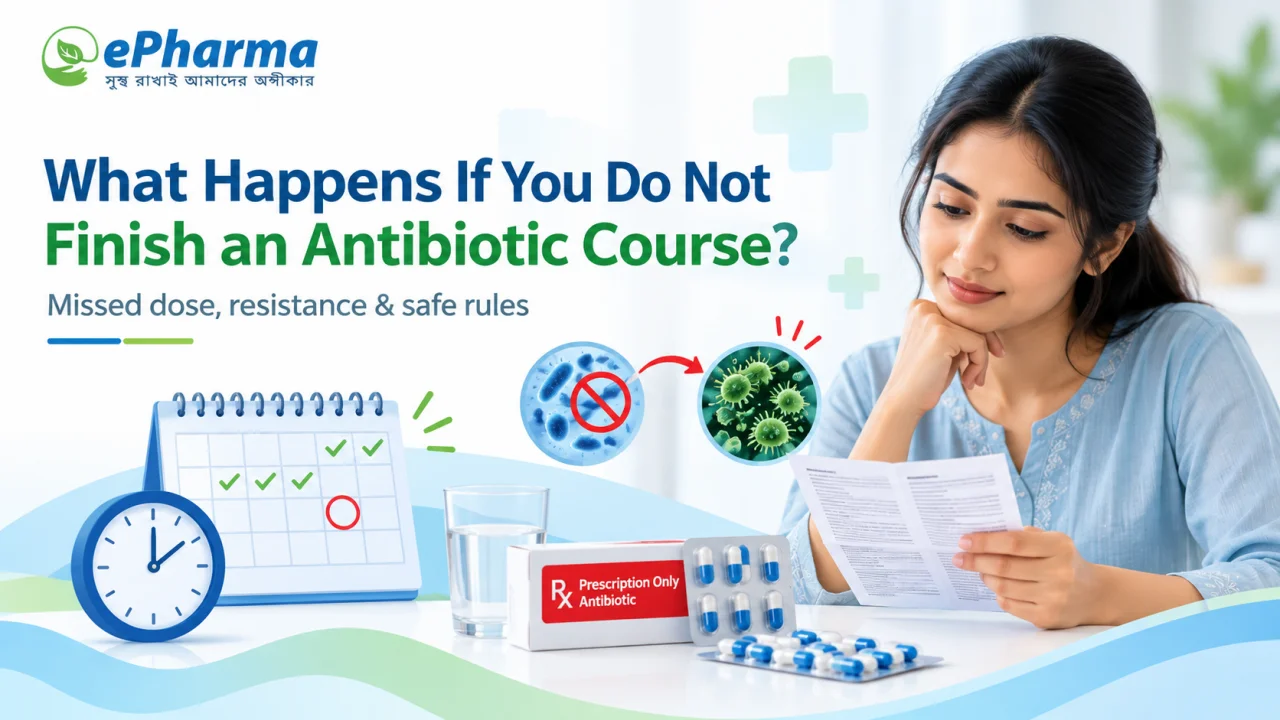
Feeling better after a few days? Learn why antibiotic duration should be clinician-led, what to do after a missed dose, how resistance develops and why viral colds do not need antibiotics.
“The fever is gone after three days. I’ll keep the remaining tablets for next time.” It sounds practical, but antibiotic treatment should not be started, shortened or extended based on how you feel alone.
The safest rule: follow the antibiotic, dose, timing and duration your clinician prescribed. Do not stop just because you feel better, but do not assume that a longer course is always better either. The right duration depends on the infection, medicine and clinical response.
What are antibiotics, and when do they work?
Antibiotics treat bacterial infections. NHS guidance says they do not work for viral infections such as colds, flu and most coughs. Dengue is also viral.
A bacterial infection can sometimes develop after a viral illness, but that is a diagnostic decision. Self-starting a “strong antibiotic” from a pharmacy is not a safe shortcut.
How serious is antibiotic resistance in Bangladesh?
Bangladesh AMR surveillance data covering 96,477 samples in 2024–25 reported:
| Finding | Reported figure |
|---|---|
| Pan-drug resistance in ICU patients | 41% |
| Multidrug-resistant organisms overall | 46% |
| Multidrug resistance in ICU samples | 89% |
| Ceftriaxone resistance | 40.1% (2022) → 52.2% |
| Meropenem resistance | 46.7% → 71% |
| WHO Watch-group share of antibiotic use | about 91% |
These are surveillance figures, not treatment instructions for an individual patient. Their value is in showing how serious antimicrobial resistance has become.
Should everyone always “finish the course”?
Bangladesh DGDA guidance tells patients to complete the doctor-prescribed course. At the same time, a 2017 BMJ analysis argued that unnecessarily prolonged antibiotic exposure can also drive resistance, and that longer treatment is not automatically better for every infection.
The practical patient rule is:
- Do not shorten the course on your own.
- Do not extend the course on your own.
- Follow the duration your clinician prescribed.
- If you feel better early or develop side effects, ask the prescriber before changing treatment.
What if you miss a dose?
NHS guidance says:
- take the missed dose when you remember
- if it is almost time for the next dose, skip the missed one
- do not take a double dose
Exact instructions can vary, so follow the packet, leaflet or pharmacist advice for your medicine.
Do antibiotics need to be taken at exact times?
Regular timing is useful, but avoid assuming that every twice-daily medicine must be exactly 12 hours apart or every three-times-daily medicine exactly 8 hours apart. Follow the prescription and product instructions.
Before food or after food?
It depends on the antibiotic. Some are taken with food and others on an empty stomach. Follow the label, prescription or pharmacist instruction.
Why are antibiotics prescription-only?
Bangladesh DGDA guidance treats antibiotics as prescription-only medicines. A 2025 public notice also addressed red-label packaging and sale documentation.
The purpose is to reduce wrong-drug use, unnecessary treatment and inappropriate duration.
What does the red label mean?
DGDA guidance requires antibiotic packaging to carry a red label. For patients, the practical message is simple: antibiotics should not be bought and used casually without a registered clinician’s prescription.
Why do antibiotics not help colds, flu or most coughs?
Because these illnesses are usually viral. Antibiotics target bacteria, not viruses.
If a clinician suspects a secondary bacterial infection, treatment may be different—but that decision needs assessment.
What about dengue?
Dengue is viral. A Bangladeshi medicine specialist has warned against taking antibiotics simply because dengue fever is present. A proven bacterial co-infection is a separate clinical situation.
What side effects can antibiotics cause?
NHS guidance lists common effects such as nausea, vomiting, bloating, indigestion and diarrhoea. Most people do not develop serious side effects when antibiotics are used correctly.
Seek urgent medical assessment for a severe reaction, breathing difficulty or rapidly worsening illness.
What should you do with leftover antibiotics?
- do not keep them for the next illness
- do not give them to another person
- do not dispose of expired or damaged antibiotics into soil, water or open rubbish
- DGDA guidance advises returning them to a pharmacy
What is antibiotic resistance?
Antibiotic resistance happens when microorganisms change so that antibiotics no longer work as well against them. It is not simply your body “getting used to” the medicine.
Resistance can make infections harder to treat and reduce the number of effective treatment options.
Common mistakes to avoid
- starting an antibiotic without a prescription
- stopping early on your own because you feel better
- using leftover antibiotics for a new illness
- sharing antibiotics with family or friends
- doubling the next dose after a missed dose
- asking for antibiotics for a cold or flu
Common myths
- “I feel better, so I can stop.” Not without discussing it with the prescriber.
- “A longer course is always better.” No. Duration is infection-specific and clinician-led.
- “Antibiotics help colds and flu recover faster.” They do not treat viruses.
- “If I miss one, I should take two next time.” NHS advises against double dosing.
- “Resistance means my body got used to antibiotics.” The microorganism becomes resistant.
Frequently asked questions
What happens if you do not finish an antibiotic course?
The infection may not be adequately treated and resistance can become a concern. Do not change the prescribed duration on your own.
Can you stop when you feel better?
Not on your own. If a shorter course is appropriate, the clinician should decide.
What if you miss a dose?
Take it when you remember unless the next dose is close. Do not double the dose.
Do antibiotics treat colds or flu?
Usually not. NHS says antibiotics do not work against viral colds, flu and most coughs.
Can you buy antibiotics without a prescription?
Bangladesh DGDA guidance treats antibiotics as prescription-only medicines.
What is antibiotic resistance?
It is when microorganisms become resistant and antibiotics stop working as effectively.
What should you do with leftover antibiotics?
Do not reuse or share them. DGDA guidance supports returning expired or damaged antibiotics to a pharmacy.
Related reading
Sources
- IEDCR AMR surveillance coverage — The Daily Star Bangla, 25 November 2025.
- IEDCR AMR Surveillance Bangladesh 2025 coverage — Dhaka Times, 2 August 2026.
- DGDA antibiotic guidance coverage — Ittefaq, 22 November 2025.
- BMU AMR report coverage — The Daily Ittefaq, 8 December 2025.
- NHS — Antibiotics; missed-dose guidance.
- BMJ/PJM discussion on antibiotic-course duration, 2017.
- Prof. Dr Md Faizul Islam Chowdhury — Jugantor, 5 October 2024.
This article is for general health information. A registered clinician should decide which antibiotic, dose and duration are appropriate. Do not start, change or stop antibiotics on your own.
Related Products