Kidney Stones: Diet, Stone Size and When Procedures Are Needed
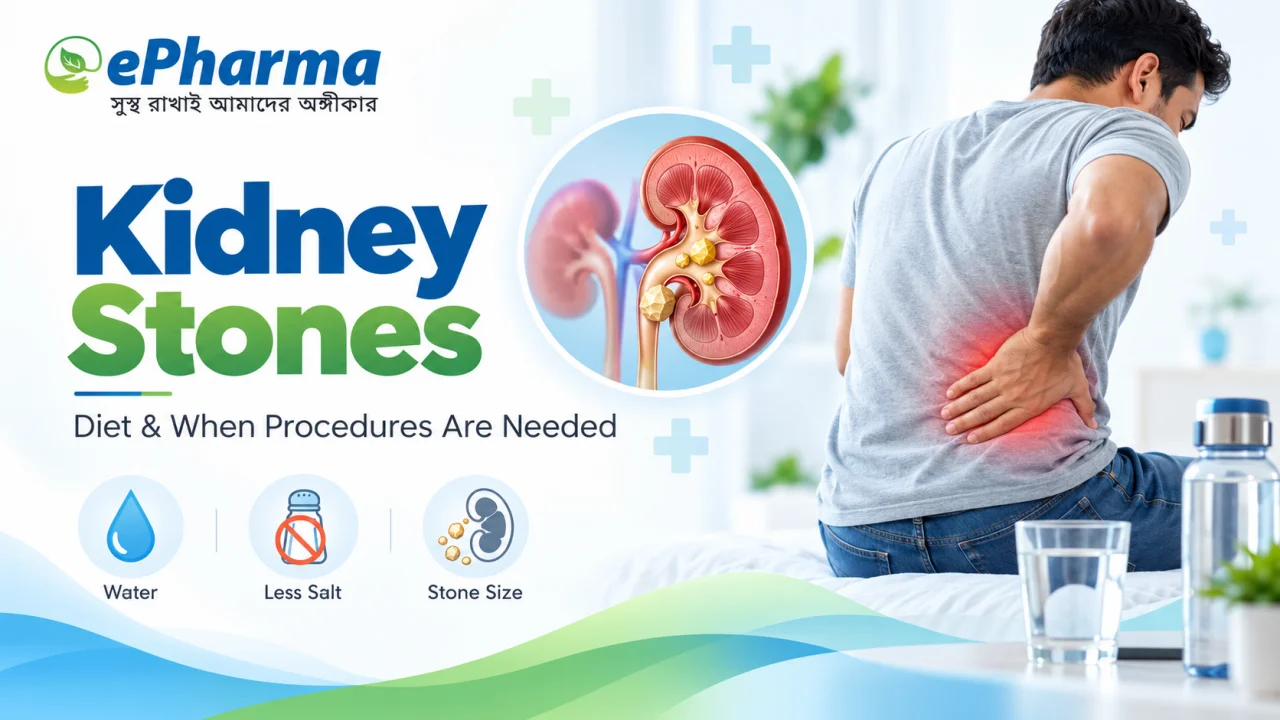
Learn what to eat with kidney stones, why dietary calcium matters, what 5–10–20 mm stone sizes mean, and when SWL, URS or PCNL may be needed.
At 3 a.m., a sharp pain starts in one side of your back and rolls toward the lower abdomen in waves. You feel nauseated and cannot get comfortable. Kidney-stone pain can feel exactly like that. Once a scan finds a stone, two questions usually follow: what should I eat, and how big does a stone need to be before a procedure is needed?
The key point is that treatment is not decided by millimetres alone. Stone location, obstruction, infection, ongoing pain, stone growth, kidney function and stone type all matter. “10 mm means surgery” is too simplistic.
What is a kidney stone?
A kidney stone is a solid deposit formed from minerals and other substances in urine. A small stone may pass on its own, but even a small stone can become urgent if it blocks urine or is associated with infection.
This article focuses on diet, hydration and treatment decisions by size. Symptoms are covered separately in our kidney-stone symptoms guide.
Who is more likely to develop stones?
A Bangladeshi nutrition specialist has highlighted dehydration and working in hot environments without enough water as important risk factors.
| Risk factor | Why it matters |
|---|---|
| Low fluid intake / heavy sweating | Urine becomes more concentrated |
| High sodium intake | Raises stone risk |
| High animal-protein intake | Can raise calcium- and uric-acid-stone risk |
| High uric acid / gout | Linked with uric-acid stones |
| UTI or urinary obstruction | May increase complication risk |
| Overweight | Especially relevant to uric-acid stones |
What should you eat and drink?
1. Water comes first
The Bangladeshi source recommends roughly 10–12 glasses of water daily or about 40–45 ml/kg in general adults. NHS advice for small stones may go up to about 3 litres/day.
If you have heart failure, advanced kidney disease or a prescribed fluid restriction, do not increase fluid on your own.
2. Reduce sodium
NIDDK says higher sodium intake increases kidney-stone risk. Cut down on heavily salted foods, processed snacks, instant foods and added table salt.
3. Moderate animal protein
NIDDK notes that eating animal protein may increase stone risk. Replacing some meat with plant protein may help, depending on stone type and nutritional needs.
4. Do not automatically cut out dietary calcium
This is one of the biggest kidney-stone myths. NIDDK says that the right amount of calcium from food can bind substances such as oxalate in the digestive tract and may help reduce stone formation.
Do not start or stop calcium supplements without medical advice.
5. If you have calcium-oxalate stones
NIDDK lists high-oxalate foods such as spinach, nuts, peanuts, wheat bran and rhubarb. These foods are not automatically banned for everyone; dietary advice should match your stone type.
6. If you have uric-acid stones
Moderating red meat and excess animal protein may help. Weight loss is particularly important if you are overweight.
Why does stone type matter?
Calcium oxalate, calcium phosphate, uric acid and cystine stones do not have exactly the same prevention strategy. If a stone is passed or removed, laboratory analysis can help guide prevention.
How does size affect spontaneous passage?
An important distinction: spontaneous-passage data are most useful for ureteral stones. A stone sitting inside the kidney is a different clinical situation.
| Stone size | General pattern | What it means |
|---|---|---|
| <5 mm ureteral stone | Most pass spontaneously | Observation may be reasonable if there is no infection or obstruction |
| 5–10 mm ureteral stone | Passage becomes less likely; older pooled data suggest around half | Observation or medical expulsive therapy may be considered |
| 10–20 mm | Spontaneous passage is less likely | SWL, URS/RIRS or PCNL choice depends strongly on location and stone features |
| >20 mm renal stone | Large stone burden | Current EAU guideline recommends PCNL as first-line in most uncomplicated cases |
So a 10 mm cutoff is not a universal surgery rule. Current EAU guidance combines size with location, obstruction, infection, symptoms, stone growth and patient factors.
When is active stone removal considered?
Current EAU guidance lists reasons such as:
- stone growth
- obstruction
- infection
- persistent pain or haematuria
- high-risk stone former
- patient preference or practical factors such as occupation/travel
What are SWL, URS and PCNL?
Shock-wave lithotripsy (SWL / ESWL)
Shock waves are delivered from outside the body to fragment the stone. Selected renal stones up to around 20 mm may respond well, although lower-pole location and dense stones can reduce success. More than one session may be needed.
Ureteroscopy (URS)
A thin scope is passed through the urinary tract to remove the stone or break it with laser. It is commonly used for ureteral stones, especially larger stones or stones that have not passed.
Percutaneous nephrolithotomy (PCNL)
A small tract is made through the back into the kidney to remove or fragment the stone. Current EAU guidance recommends PCNL as first-line treatment for most renal stones over 20 mm.
Does “surgery” mean a large abdominal incision?
Usually not. Most modern stone procedures are minimally invasive: SWL, URS/RIRS and PCNL have greatly reduced the need for open surgery.
Can medicines dissolve kidney stones?
A Bangladeshi urologist has explained that there is no broadly effective medicine that simply “melts” ordinary stones. Small stones may pass on their own, and selected ureteral stones may be helped by prescription medical-expulsive therapy.
Exception: uric-acid stones can sometimes be dissolved through clinician-supervised urine alkalinisation. This requires the right diagnosis and monitoring.
What should you do during renal colic?
NHS treatment guidance includes pain relief and anti-sickness medicine. If you have kidney disease, ulcer disease, are pregnant, dehydrated or take blood thinners, pain-medicine choice should be discussed with a clinician.
If vomiting prevents you from keeping fluids down, seek medical assessment.
When is urgent care needed?
- fever or chills with stone pain
- little or no urine
- pain that cannot be controlled
- repeated vomiting or dehydration
- a single kidney or significant kidney disease
- severe flank pain during pregnancy
- heavy visible blood/clots or rapidly worsening illness
Fever with an obstructing stone can signal a serious infection and should not be watched at home.
Common mistakes
- cutting out milk and dietary calcium automatically
- using the same diet for every stone type
- assuming 10 mm always means surgery
- believing every stone can be dissolved with medicine
- treating fever and chills as “normal stone pain”
- delaying care for unproven “stone-melting” remedies
Common myths
- “Calcium stone means stop calcium foods.” Not necessarily; appropriate dietary calcium is usually maintained.
- “A small stone cannot be dangerous.” Obstruction or infection can make even a small stone urgent.
- “10 mm always means surgery.” Size is only one part of the decision.
- “All kidney stones dissolve with medicine.” No. Selected uric-acid stones are an exception.
Frequently asked questions
What should you eat with kidney stones?
Drink enough water, reduce sodium, keep animal protein moderate and maintain appropriate dietary calcium. Oxalate or uric-acid restrictions depend on stone type.
Should you stop milk and yoghurt?
Usually no. NIDDK advises getting the right amount of calcium from food rather than automatically eliminating it.
Will a 5 mm stone pass?
Most ureteral stones under 5 mm pass spontaneously if there is no obstruction, infection or other complication.
Does a 10 mm stone always need surgery?
No. Location, kidney versus ureter, symptoms, obstruction, infection and stone characteristics all matter.
What about a renal stone over 20 mm?
Current EAU guidance recommends PCNL as first-line treatment in most uncomplicated cases.
Can medicine dissolve a stone?
Most stones cannot simply be dissolved. Selected uric-acid stones can sometimes be treated with supervised dissolution therapy.
When should you go to hospital urgently?
Seek urgent care for fever/chills, little or no urine, uncontrolled pain, repeated vomiting, a single kidney or severe pain during pregnancy.
Related reading
Sources
- Md. Iqbal Hossain — Prothom Alo, 12 July 2025.
- Dr Kazi Zikrur Razzak — Prothom Alo, updated 2 October 2024.
- NIDDK — Eating, Diet & Nutrition for Kidney Stones.
- EAU Guidelines on Urolithiasis — 2026.
- NHS — Kidney stones: Treatment.
- IQWiG / InformedHealth — Treatment options for kidney stones.
This article is for general health information. Stone size alone does not decide treatment; location, obstruction, infection, kidney function and stone type all matter. Seek urgent care for fever/chills or inability to pass urine.
Related Products